Summarize a long PDF before your meeting
A forty-page report and twenty minutes to spare. Here's how to attach a PDF in VIGPT, what to ask, and the limits worth knowing before you start.
 VIGPT Team3 min read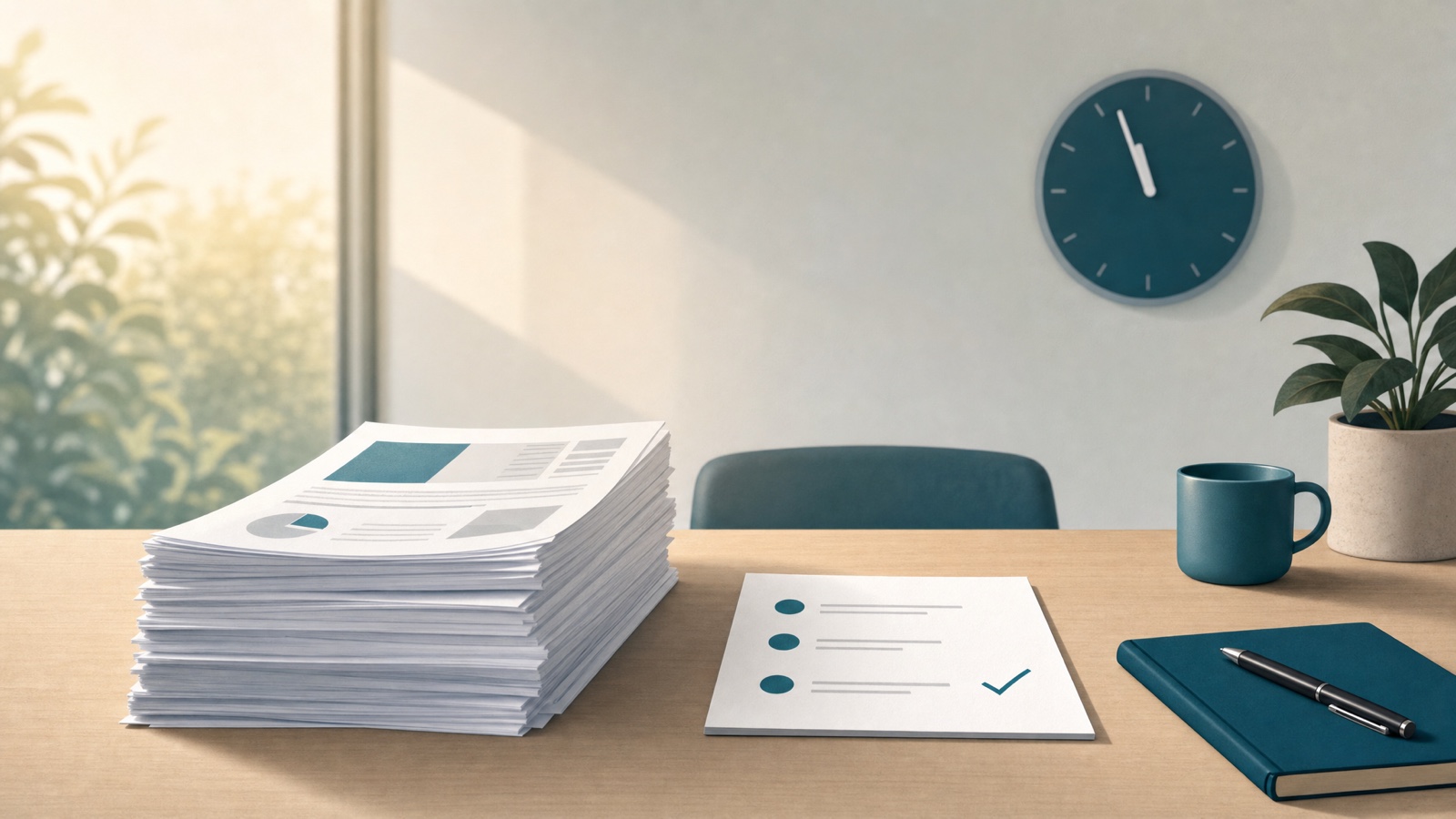
On this page
The meeting's at 11, and the report you were meant to read is forty pages. Reading all of it won't take long — you just don't have the time. But walking in without knowing what's inside isn't a great option either.
This is one of the first things most people do with VIGPT. Here's the whole path.
Attach the file
In the message bar, the add photo and file button attaches your file. The accepted formats are JPEG, PNG, and PDF.
PDFs upload up to 15 MB. If the file is large, it's compressed automatically before it reaches the model — nothing to do on your end. You'll only see an error if compression still can't get it small enough, and in that case you'll want to split the file into smaller parts.
Ask the right question
The file on its own isn't enough — what you ask decides how useful the summary is. "Summarize this" works, but you'll get a generic recap that may not fit your meeting.
Better to say what the summary is for:
- "Summarize this report in 5 key points and tell me what needs a decision."
- "What are the biggest risks raised in this contract?"
- "What does this document say about the budget?"
- "What three questions should I ask in the meeting?"
The difference between "summarize this" and "tell me what needs a decision" is the difference between a shorter document and actually being ready for the meeting.
Keep asking about the same file
You don't need to attach the file again for every question. The attached PDF stays in the conversation, so you can ask in sequence: the summary first, then a question about one section, then a list of questions for the meeting.
One thing worth knowing: each conversation keeps one PDF active — the last one you attached. If you attach a second PDF, later questions are answered about the new file, and the earlier one drops out of the conversation. To compare two documents, start a separate chat for each.
Let Auto pick the model
Not every model reads PDFs. If you've pinned a specific model and it doesn't support PDFs, you'll get a message asking you to pick a compatible one.
The simplest approach is to stay on Auto. When you attach a file, Auto knows this message needs a model that can read the document, and it picks accordingly. You don't need to know which model can do what.
Limits worth knowing first
- Free accounts: one attachment per message. Upgrade your plan for more.
- Paid plans: up to 10 attachments per message.
- Hourly cap: up to 30 files per hour.
- Scanned PDFs: if the document is an image of paper pages with no selectable text, the result depends on the image quality.
In short
Attach the file, stay on Auto, and instead of "summarize this," say what the summary should do for you. Those three things turn forty pages into something you can read in the ten minutes before your meeting.
Related posts
- Guides
Rewriting and editing text with VIGPT
Shorten, clarify, change tone, fix mistakes, and translate. With example prompts, this guide shows how to take a piece of text you already have and shape it into what you want in VIGPT.
4 min read - Guides
Getting started with video generation in VIGPT
Video generation in VIGPT is a Pro and Max feature. This guide shows how to switch to video mode, what to write, how to pick the aspect ratio and duration, and how to get the result, which arrives asynchronously.
4 min read - Guides
Setting up an organization workspace for your team
One shared wallet, a dedicated plan for each member, and one console to manage everyone. This guide walks through setting up an organization workspace in VIGPT, step by step — from requesting one to assigning member plans.
3 min read